
This post was originally published on this site.
Ambitious copper investment plans across the Andes could fail to deliver the production growth governments expect unless miners overcome financing, infrastructure and operational bottlenecks, according to GEM Mining Consulting.
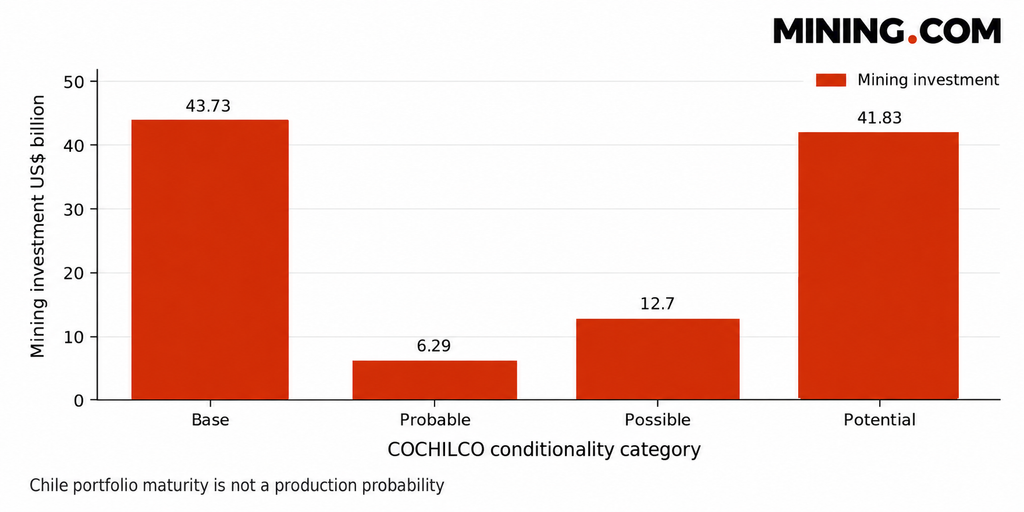
Peru’s 2026 mining portfolio includes 66 projects worth an estimated $64.1 billion, while Chile’s investment pipeline totals $104.5 billion for 2025–2034. Argentina could also benefit from a US Export-Import Bank financing framework intended to mobilize up to $7 billion through 2027.
“Copper announced is not copper delivered,” GEM said in its report, arguing that investment commitments and production forecasts offer little assurance of how much metal will ultimately reach customers.
The warning comes as the International Energy Agency’s 2026 base-case mine pipeline points to an approximately 25% shortfall against projected primary copper requirements by 2035 under its Stated Policies Scenario. The estimate accounts for secondary supply and refining losses, underscoring the importance of bringing new mines into production.
Yet GEM cautions that the scale of announced investment can obscure a fundamental distinction between maintaining existing operations and generating additional output.
Production gap
Chile illustrates the challenge. Much of its mining investment portfolio involves brownfield projects designed to sustain production, replace declining capacity or expand existing operations.
Such investments can protect significant volumes of copper without necessarily increasing national output.
GEM offers a hypothetical example of a mine initially producing 100,000 tonnes annually. Without further investment, production falls to 80,000 tonnes by 2030. Routine sustaining expenditures maintain output at 96,000 tonnes, while an expansion raises production to 126,000 tonnes.
Although the expansion scenario produces 46,000 tonnes more than the no-investment case, only 30,000 tonnes represent additional output beyond what ordinary sustaining investment would have delivered.
The distinction matters when governments assess the economic benefits of regulatory reforms, subsidies and infrastructure spending.
Peru faces a similar accounting challenge as it pursues plans to add approximately one million tonnes of annual copper production within five or six years.
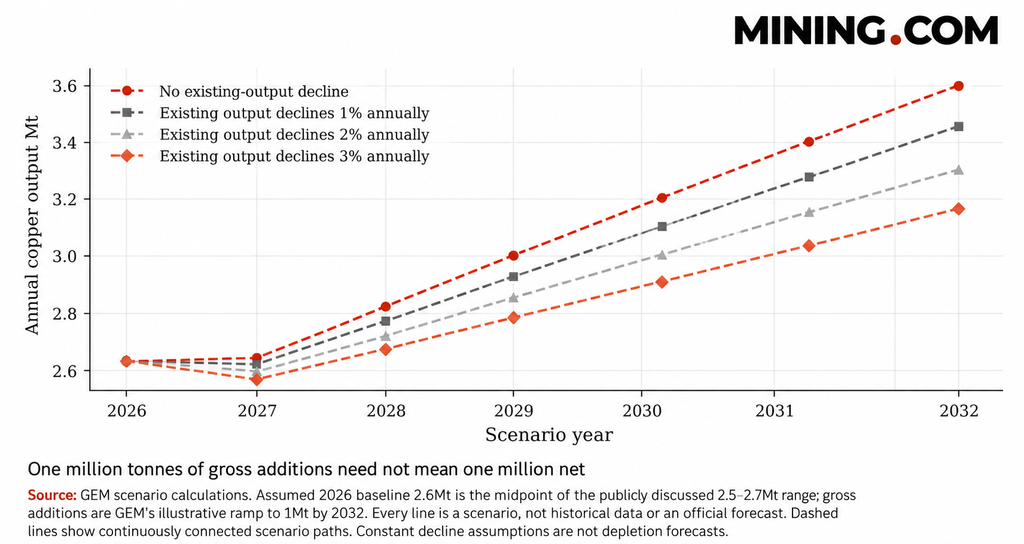
Using an illustrative starting point of 2.6 million tonnes, GEM estimates that one million tonnes of gross additions by 2032 would lift national production to 3.6 million tonnes if existing operations maintained their output.
However, annual declines of 2% at existing mines would reduce the projected total to approximately 3.3 million tonnes, representing just 700,000 tonnes of net growth. A 3% annual decline would cut that gain to roughly 570,000 tonnes.
The figures are scenarios rather than official forecasts, but demonstrate how depletion and operational losses could erode the benefits of new developments.
Project maturity presents another obstacle. GEM distinguishes between Nueva Centinela, an expansion under construction, Tía María, a new cathode mine reporting construction progress, and Vicuña, a district-scale development still at the preliminary assessment stage.
Treating their proposed production volumes as equally certain would exaggerate the reliability of future supply estimates.
Financing hurdles
Regulatory changes could accelerate development, although GEM argues that removing administrative barriers does not necessarily shorten the time required to deliver commercial production.
Peru’s proposed elimination of 27 procedures, for example, would need to address delays along a project’s critical development path to produce measurable benefits.
In one hypothetical scenario, shortening legal approvals alone fails to advance production because utility connections remain the limiting factor. Coordinated improvements across several activities deliver greater benefits.
Infrastructure economics introduce further complications, particularly for projects dependent on shared power, transport and export facilities.
GEM calculates that a three-user shared infrastructure system could save $40.56 million annually compared with separate facilities under its assumed operating conditions.
If only two users proceed, their combined standalone infrastructure costs would total $152.22 million annually, compared with $187.78 million for the unchanged shared system.
The analysis suggests that shared infrastructure is not automatically the cheapest option, especially when project schedules diverge or anticipated participants fail to advance.
Argentina’s proposed financing framework could help unlock investment, but GEM notes that it does not constitute an approved mine loan or a dedicated copper allocation. Individual projects must still secure financing, eligible procurement arrangements and commercial agreements.
Workforce availability adds another constraint. Chile’s CCM–Eleva projection identifies nearly 37,000 new-worker requirements through 2034, reflecting both replacement needs and investment-driven demand.
That estimate is specific to Chile rather than a measure of shortages across the Andes. Nevertheless, GEM identifies skilled personnel, commissioning expertise and equipment availability as essential to converting installed capacity into sustained production.
For mining companies and policymakers, the report’s central implication is that success should be measured against credible production baselines, not the headline value of investment announcements.
GEM recommends evaluating projects through documented milestones, financing commitments and evidence of commercially accepted output. Such assessments would help determine which developments merit further capital and which still face obstacles capable of delaying production.


