
This post was originally published on this site.
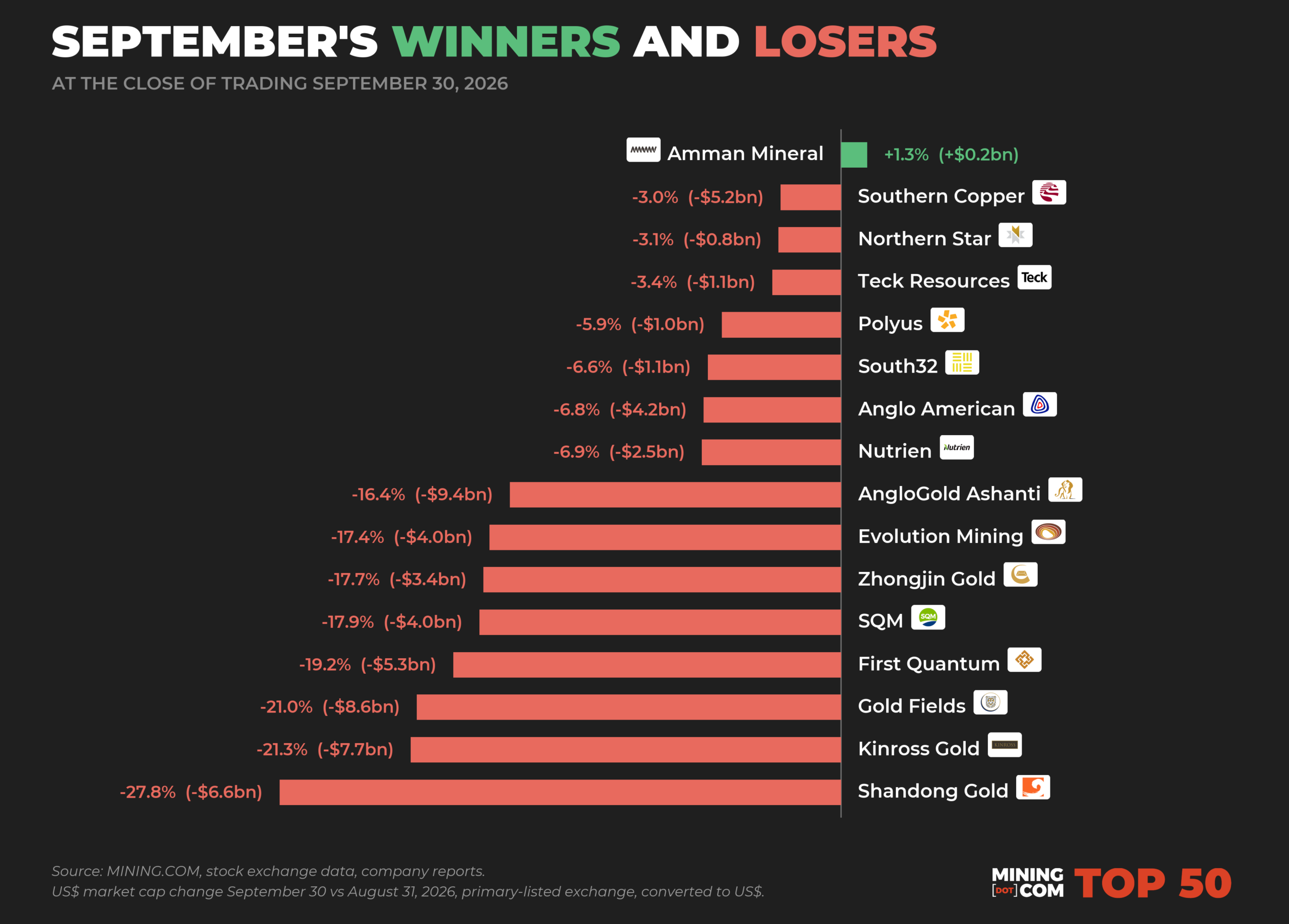
The world’s 50 most valuable mining stocks were worth $2.26 trillion at the close of September – the second-largest monthly decline in the history of the ranking.
September took back three quarters of August’s record $357 billion advance, and it did so for the same reason the gain arrived: gold. Bullion futures in New York slid from $4,441 an ounce at the end of August to $4,158 at the end of September, a 6.4% retreat that leaves the metal below where it started the year.
The macro picture all worked against gold which relies solely on price appreciation to create investor returns. The Federal Reserve raised rates for the first time since 2023 on September 16, a global bond selloff pushed yields to their highest since 2008 and the dollar firmed. As is its wont, silver fell harder, 9% for the month, while PGMs continued to delve deeper into negative territory.
Copper and iron ore, the two metals that matter most to the top of the table, ended the month almost exactly where they began. Lithium looked like it was reaching escape velocity only a few months ago but lost more than a fifth of its value in September alone, and now only shows a small gain for 2026.

Gold gives it back
The gold miners that supplied $138 billion of August’s gain gave up $79 billion of it in September, a 12.7% fall across a sector that now counts fifteen companies and not one of them higher on the month. Newmont and Agnico Eagle both suffered double digit billion dollar damage which was enough to push Agnico back below the $100 billion mark it had cleared only a month earlier. AngloGold Ashanti, the leader on the way up in August, fell 16.4% on the way down and shed $9.4 billion.
The sharpest falls had company-specific causes stacked on top of the metal. Kinross lost 21.3% after it cut its 2026 and 2027 production guidance by about 8% from the midpoint, blaming a run of winter storms at La Coipa in Chile and weaker grades at Round Mountain in Nevada. Its shares dropped more than a tenth in a single session.
Shandong Gold fell 27.8%, the worst move in the ranking, after its board lowered the group’s 2026 mined gold target to between 1.16 million and 1.22 million ounces from a plan of at least 1.58 million ounces. Zhongjin Gold, its Beijing-based peer, lost 17.7%.
Gold Fields pays for its ambition
The month’s most expensive decision belonged to Gold Fields. The Johannesburg miner’s unsolicited A$38.7 billion ($27 billion) approach for Northern Star, which would have created the world’s second-biggest gold producer, was rejected as “highly opportunistic” by the Australian company’s board on September 28.
Gold Fields’ shares fell 12% in Johannesburg on the day and 21% over the month, an $8.6 billion loss of market value, and the company is said to be weighing a larger cash component to tempt the target back to the table. Northern Star, the prize, was the best-performing gold miner in the ranking at 3.1% lower, the premium in the bid cushioning it against the metal.
Copper records record then fades
Copper’s producers lost $44 billion between them, a 7.6% fall that looks almost orderly beside gold’s 12.7%, and the metal itself finished the month at $6.56 a pound ($14,500 a tonne), three cents below where it began. In between it set a fresh record as a stalled US tariff proposal drained London and Shanghai warehouses, then gave the gains back when the White House hesitated.
Southern Copper fell 3.0% to $171 billion and ended a quarter in second place for the first time. The Mexican-Peruvian producer first dislodged Rio Tinto from the number two spot in January, lost it again in the March selloff, overtook Rio briefly in August and closed that month $600 million behind it. At the end of September the gap was $9.9 billion the other way, with Rio Tinto down 8.9% and $15.8 billion lighter as iron ore stayed stuck below $100 a tonne.

Teck Resources was the other copper name to hold its ground, down 3.4% as it waits on the final regulatory decisions in China and South Korea that stand between it and the Anglo Teck merger. BHP suffered the largest dollar loss anywhere in the ranking, $26.4 billion or 11%, after a worker was killed at Escondida on September 23 and the world’s largest copper mine suspended operations, with supervisors voting for strike action in the same week. Freeport-McMoRan fell 7.6% to $100.5 billion, keeping its membership of the $100 billion club by the narrowest of margins. The club counts six names at the end of September against seven in August.
Only one company in the fifty finished higher. Amman Mineral, the Indonesian copper and gold producer that plans to double copper cathode output this year from its rebuilt smelter, gained 1.3%.
Quantum mechanics
First Quantum lost 19.2% in September, almost all of it on the last day of the month. A three-minister commission in Panama recommended that the government negotiate a restart of Cobre Panama on terms that would pay for the mine’s eventual closure without the state footing the bill, one of 17 recommendations that followed an audit by Swiss consultants. The report makes the termination of $27 billion in pending arbitration claims a condition of any agreement, and, somewhat inexplicably given copper’s rosy long term outlook, rules out any extension of the operating period or expansion of the site. Just as well then that First Quantum’s Cobre expansion to a 100 million tonnes per year operation which places it in the top 3 worldwide, was well under way before the shutdown. The decision now rests with President José Raúl Mulino.
The Toronto-listed shares fell as much as 36% during the session on September 30 before trading was halted, and closed 15% lower on the day. Analysts at Scotiabank and BMO both argued the selling was overdone, with Scotia’s Orest Wowkodaw calling it a buying opportunity and BMO’s Matthew Murphy pointing out that the 2023 court ruling struck down the contract rather than mining itself, which leaves room for a negotiated restart that could run for decades. Cobre Panama supplied about 40% of First Quantum’s revenue and 1.5% of the world’s copper before it was shut in 2023. The company is processing stockpiled ore under a government-approved plan and expects 30,000 to 40,000 tonnes of copper from it this year.
Lithium stockpiles hurt lithium stocks
The battery metal was the month’s worst-performing by a country mile. Carbonate futures in Guangzhou fell 22.5% to 122,800 yuan ($18,300) a tonne, the lowest close since the first week of January and 39% below the two-year high above 200,000 yuan ($29,500) set in mid-May.
Supply disruptions were not enough to turn sentiment after China’s biggest lithium mine, CATL’s Jianxiawo, went back on care and maintenance at the start of the month after regulators revoked its environmental approval. What broke the market was a head scratcher: a change in methodology at a Chinese price reporting agency more than doubled reported stockpiles to 175,000 tonnes and knocked 14% off the price in three days, and the selling did not stop there.
A metal that was up almost 70% for the year at its peak now shows a gain of less than 4%. The equities have fared worse. Albemarle and Ganfeng Lithium each lost more than a fifth of their value in September and both now trade at less than half their 52-week highs, leaving Albemarle down 25% in 2026 and Ganfeng down 32%. Three lithium producers made the ranking at the end of August. SQM, itself 17.9% lower and 36% off its high, is the only one left. That is down from six slots at the height of the EV demand craze in late 2022, which sent lithium carbonate prices in China to almost 600,000 yuan (about $84,000) a tonne.
Lithium’s places were taken by two gold miners: Endeavour Mining at 49th and Alamos Gold at 50th, back in the ranking a month after it slipped below the line. The price of admission fell to $13.6 billion from $15.6 billion in August, the lowest cut-off since June and a long way below the $19.5 billion it took to make the fifty at February’s peak.

For a sense of how far the bottom of the table has travelled, the fiftieth company was worth $3.4 billion at the Covid low in March 2020 and $6.3 billion as recently as the end of 2024.
Zijin out of sorts
Every mining address lost ground in September, and China lost the most. The six Chinese companies in the ranking lost $43 billion between them, 15% of their value, with Zijin Mining alone accounting for $19 billion of the fall.
Zijin fell 14.2% to $115 billion. The Fujian-based company fell in step with Chinese peers as the gold price slid, with Shandong Gold down 27.8%, Zhongjin Gold 17.7% and CMOC 13.4%. Zijin is now as much a gold stock as a copper one. First-half gold output rose 15% to just over 1.5 million ounces while copper production fell 6%, and its listed gold unit added to that exposure by taking control of rival Chifeng Gold in a $2.6 billion deal. The stock is now down 7.5% for the year and about a third below its 52-week high.
Canada moved back ahead of Australia as the most valuable mining address, $488 billion against $484 billion, reversing August’s photo finish, as BHP’s fall outweighed anything that happened to the Canadian names. The United States is third at $307 billion.

A shoddy month in a spiffy year
September’s $264 billion is the second-largest monthly loss in a series that runs back to the end of 2019, behind only March, when $434 billion disappeared as gold fell away from its record. Even so, the third quarter closed $107 billion higher than it opened and the ranking is still worth $118 billion more than at the end of last year.
The longer view is more flattering still. The fifty were worth $698 billion at the Covid low in March 2020, took 42 months to regain the $1.68 trillion peak of the 2022 commodity spike, then doubled in the thirteen months to January 2026. At $2.26 trillion the ranking sits $486 billion, or 18%, below the February record.
The distance to the highs is wider still at company level. Had every one of the fifty closed September at its own 52-week high, the ranking would be worth $2.97 trillion, $709 billion or 31% more than it is. Most of those peaks are not far in the past: 33 of the 47 companies with a full year of trading set their 52-week high in the first quarter, when gold ran to $5,420 an ounce, and ten more set theirs in late August or the first week of September, among them BHP, Southern Copper, Newmont, Freeport-McMoRan, Glencore and Anglo American.
More than thirty of the fifty have set all-time highs at some point in 2026. The Chinese names have the longest road back, with Shandong Gold 58% below its peak and Zhongjin Gold, Amman Mineral, China Northern Rare Earth and Jiangxi Copper all more than 40% adrift, while South32, Anglo American and Teck are within 8% of theirs.

METHODOLOGY

Source: MINING.COM, stock exchange data, company reports. Share data from primary-listed exchange at the close of trading September 30, 2026, converted to US$ where applicable. Percentage change based on US$ market cap difference, not share price change in local currency.

As with any ranking, criteria for inclusion are contentious. We decided to exclude unlisted and state-owned enterprises at the outset due to a lack of information. That, of course, excludes giants like Chile's Codelco, Uzbekistan's Navoi Mining, which owns the world's largest gold mine and is in the process of readying an IPO, Eurochem, a major potash firm, and a number of entities in China and developing countries around the world.

Another consideration is diversified companies such as Anglo American with separately listed majority-owned subsidiaries. Anglo has interests in platinum (Valterra), and in the past diamonds (De Beers) and iron ore (Kumba), but the listed subsidiaries are excluded when consolidated on the parent's books. The same principle sees Hindustan Zinc enter the ranking in place of the slimmed-down Vedanta following the Indian group's demerger. Where mining arms are separately listed like Grupo Mexico's Southern Copper or Penoles' Fresnillo, those are added to the ranking and not the holding company.

Each company is assigned a single sector, and judgment calls abound. Vale appears under iron ore rather than diversified: the Brazilian company's fortunes remain overwhelmingly tied to the steelmaking ingredient, and its plans to separately list its base metals unit in Toronto (copper and nickel assets responsible for roughly a quarter of revenue) only sharpen the distinction. Rio Tinto, by contrast, stays diversified: iron ore may pay the bills, but the breadth of the portfolio, from aluminium and copper to lithium and titanium, is the company's defining feature. As a general rule we classify a company as diversified if no single commodity brings in more than 1.5 times the revenue of its next biggest earner, but as always there are exceptions.

Where the numbers are too close to call, history can settle it. Fresnillo now earns roughly as much from gold as from silver, but the Mexico City-based company is the world's largest primary silver producer and has been mining the metal at its namesake district in Zacatecas since the 1550s, so it stays under silver. Pan American Silver, where gold has come to dominate the revenue mix following the Yamana and MAG deals, keeps its silver classification on the same grounds. The company itself chose to keep the moniker after all.

Royalty and streaming companies Franco-Nevada, Royal Gold, Wheaton Precious Metals and Triple Flag are included on the basis of their deep involvement and funding role in the industry, but pure smelting and refining companies, as well as steelmakers with large mining assets, are excluded. Conglomerates and trading houses like Japan's sōgō shōsha are also excluded, which means well-known names like Marubeni, Mitsui, Sumitomo, Itochu and Mitsubishi, with their prominent stakes in mines and mining companies, do not qualify either.

Vedanta Aluminium, despite being India's largest producer of the metal, is excluded as a smelter without captive mining, and Sumitomo Metal Mining and JX Advanced Metals do not make the ranking on the same test, with smelting and refining the vast majority of their business despite attributable primary production in the hundreds of thousands of tonnes. On the flipside, rare earth miners are included. Rare earth specialists tend to aim for vertical integration (and companies like MP Materials are far along) and the refining, metalization and ultimately magnet making divisions are where the income and margins lie.

While earlier rankings included coal miners, the monthly series covers mined metals and minerals only. We exclude coal companies based on the fact that many derive most of their revenue from utilities, power generation and transport rather than mining, and, as with the steelmakers, their inclusion would crowd out the industry the ranking is meant to capture. That means no Coal India, despite the Kolkata company's standing as the world's largest coal producer. For comparability, previous rankings have been recalculated on the same basis.

Head office refers to a company's operational base where applicable (BHP and Rio Tinto both appear under Melbourne), but Antofagasta is the exception that proves the rule: we place the copper miner in London, where it has been listed since the late 1800s, rather than Chile where it mines.

Norilsk Nickel and Polyus, thanks to captive investors on the MCX, maintain their standing in the ranking despite sanctions and trading restrictions, and are valued on Moscow Exchange pricing converted to US dollars.

Please let us know of any errors, omissions, deletions or additions to the ranking, or suggest a different methodology: email Frik Els at fels@mining.com with Top 50 in the subject line.


