
This post was originally published on this site.
Copper suffered its heaviest selloff in eight months on Wednesday as speculators abandoned bets tied to the artificial intelligence boom, a surging dollar and fading US tariff prospects overwhelmed signs of acute physical shortage in China, and a break of key chart levels brought in a wave of computer-driven selling.
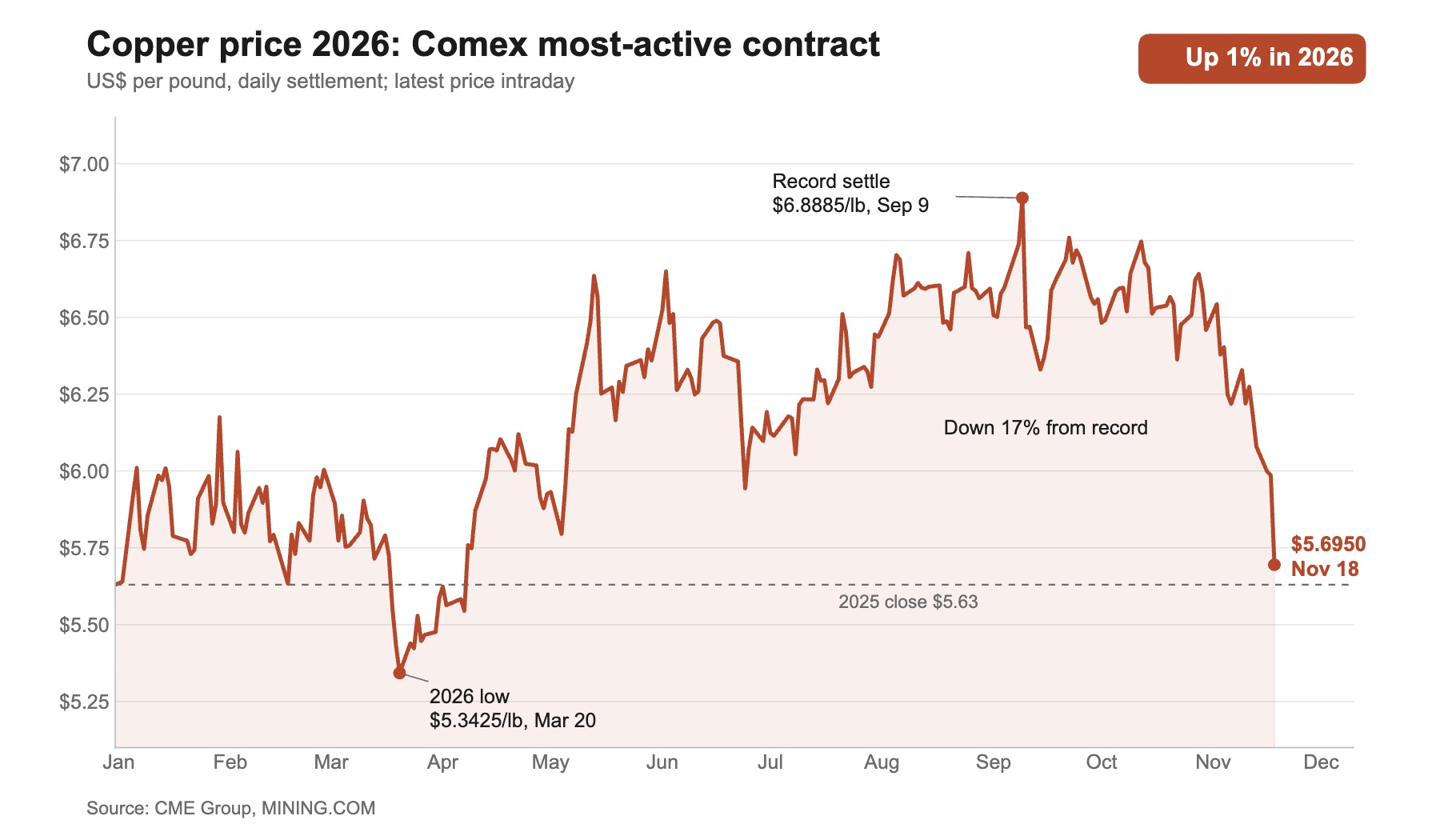
Comex copper for December delivery, the most active contract in New York, dropped 4.9% to $5.6950 a pound ($12,555 a tonne) in morning trade, the lowest since early April. The contract has fallen for five sessions in a row, is down 14% in three weeks and 17% below the record settlement of $6.8885 reached on September 9. A gain for 2026 that stood at 22% at the peak has shrunk to about 1%.
On the London Metal Exchange, three-month copper fell 3.4% to $12,772.50 a tonne in official trading and later touched $12,640, a seven-month low. The intraday loss of as much as 4.4% was the steepest since March, Bloomberg reports. In Shanghai the most-traded contract shed 3.4% to 97,920 yuan ($14,690) a tonne, and tin, the other metal most closely tied to AI hardware, slumped more than 7% in London to its lowest in almost eight months.
Underlying consumption is not helping either. “Copper demand today is closer to a recessionary-like environment than growth environment,” Nicholas Snowdon, head of metals and mining research at Mercuria, told the World Copper Conference Asia in Shanghai on Wednesday, according to Bloomberg. Natixis analysts have described the combination of US stockpiling and AI-linked investment flows as a bubble, while banks remain split on whether 2027 brings shortage or surplus.
Towel thrown in
Investors appear to be giving up after the loss of several technical levels added to momentum selling, Ole Hansen, head of commodity strategy at Saxo Bank, told Reuters, pointing to an inflation scare and the risk of higher funding costs. “AI was a trigger, but it’s not really the driver,” he said.
Tech stocks steadied on Wednesday after Nvidia reported a 103% jump in quarterly revenue to $115.8 billion late on Tuesday, the chipmaker’s first results since Jensen Huang’s exit rattled the metals demand story, but that did nothing for copper. The dollar is holding near a 19-month high ahead of the release of minutes from the Federal Reserve’s October meeting, at which two officials voted for another rate increase.
Sentiment took a further knock late on Tuesday when Stan Druckenmiller, among the best-known backers of copper’s AI trade, told a conference in Austin he is now short the metal. A filing earlier in the week showed his family office had sold out of Southern Copper and bought gold miners during the third quarter.
Fund positioning has already been cut hard. Managed money net long positions on Comex have fallen from more than 80,000 contracts six weeks ago to about 35,000, close to a 14-month low, according to Saxo. Hansen puts the next chart supports at $5.63 and $5.32 a pound. The first of those is also where copper ended 2025, so a break would put the metal in the red for the year.
Record premium, falling price
The rout comes with the physical market in China as tight as it has been in years. The Yangshan premium paid to import copper into the country jumped by about a fifth to a record $360 a tonne on Wednesday, Reuters reports, up from less than $100 in September. Shanghai Futures Exchange stocks dropped 18% last week to 27,642 tonnes, the lowest since December 2023, and the November contract expired on Monday at a premium of more than $2,000 a tonne to December, a squeeze that forced the exchange to intervene.
Investors increasingly doubt the Trump administration will press ahead with tariffs on refined copper after this month’s midterm elections, and the spike in Chinese prices has created the commercial case for traders to ship metal out of the United States, where warehouses hold roughly 85% of the 1.09 million tonnes in exchange-monitored stocks. The assumption that those inventories would stay stranded unless tariffs were formally ruled out has been shaken, Bloomberg reports.
Supply news ignored
Chile’s copper commission Cochilco expects national output to fall 8.4% this year to 4.94 million tonnes, the lowest in 23 years, after production dropped 8.5% to 3.63 million tonnes in the first nine months. The country’s leaching operations are also exposed to sulphuric acid supply: imports hit a record 3.97 million tonnes last year, about half of consumption, and China supplied 37% of that before restricting exports in May.
In Shanghai, where the industry has gathered for annual supply talks, China’s Nonferrous Metals Industry Association said concentrate-fed smelting capacity has nearly reached a ceiling and promised a monitoring mechanism to bring treatment charges back to sustainable levels. Spot charges sank to a record minus $247.20 a tonne on November 6, meaning smelters pay miners for the privilege of processing their concentrate.
The 2026 benchmark was set at zero, and 21 of 35 industry participants polled by Reuters expect a negative number for 2027, with forecasts from minus $50 to minus $150. Snowdon argued that the more negative the benchmark, the healthier the market in the long run. Freeport Indonesia is meanwhile offering 2027 cathode from its Manyar smelter to Chinese buyers at a premium of $158 a tonne, Reuters reports, citing two sources.
$140 billion in a month
Wednesday’s moves in copper stocks were modest in early New York trade, but only because the damage was already done. Eleven of the largest copper-exposed miners have lost a combined $141 billion, or 16% of their market value, over the past month, $68 billion of it in the last week.
BHP slipped 2.2% to a market value of $186 billion, some $24 billion less than a month ago and well under the $207 billion it was worth during last week’s short-lived bounce. Southern Copper has been hit hardest among the majors, down 22% in a month to $133 billion, a loss of $37 billion that has cut its 2026 gain to 13% from 41% in mid-October. Freeport-McMoRan, worth about $100 billion a month ago, has fallen 20% to $79 billion.
Rio Tinto is down 12% over the month to $136 billion, Glencore 17% to $76 billion, and Anglo American and Teck Resources 13% apiece. Lundin Mining has lost 18% and Antofagasta 11%, and both are now in negative territory for the year along with Rio.
First Quantum Minerals bucked the trend on Wednesday, adding 3.7% after Panama opened formal talks on restarting Cobre Panama, although the stock is still 16% lower over the month. Ivanhoe Mines has shed 30% in a month and 56% in 2026.
The MINING.COM TOP 50 ranking of the world’s most valuable miners had already lost $226 billion in October.
(With files from Reuters and Bloomberg)


